When to Outsource Meta Ads Services vs Running Them In-House

Introduction
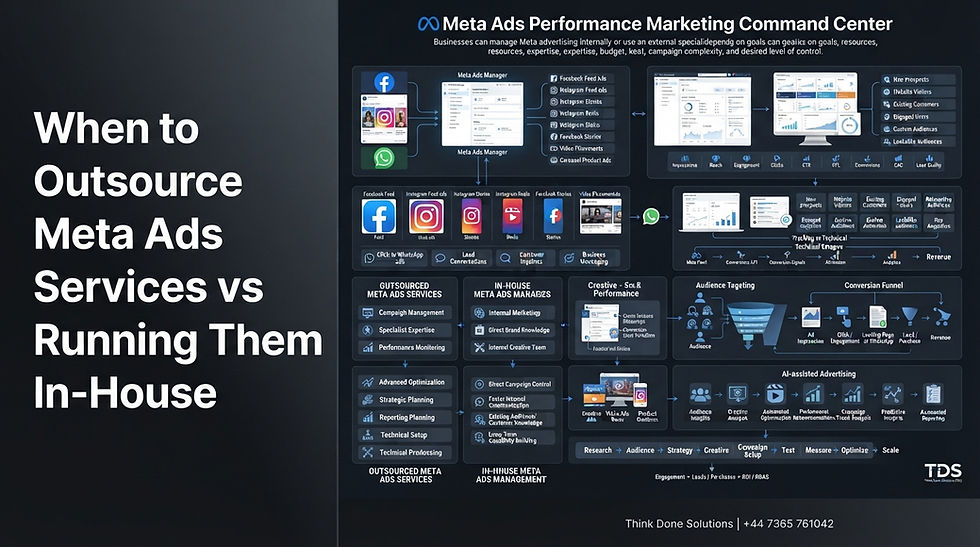
Running Meta Ads in-house can give your business direct control over campaigns, creative decisions, and customer knowledge.
Outsourcing meta ads services can give you specialist expertise, additional capacity, and a team focused on campaign performance without requiring you to build every paid-media skill internally.
Neither model is automatically better.
The right decision depends on whether your current constraint is expertise, time, workload, control, or long-term ownership of the channel.
Start With the Real Gap
Before comparing an agency fee with internal costs, identify what your business is actually missing.
Do you already have someone who understands paid social but does not have enough time to manage it properly?
Is your team producing creative but struggling with targeting, testing, or tracking?
Are campaigns becoming more complex as budgets, products, and audiences grow?
Or is Meta advertising still small enough that an internal marketer can manage it comfortably?
These questions matter because outsourcing the wrong problem will not necessarily improve performance.
If the issue is only creative capacity, you may need additional design support rather than full campaign management.
If the issue involves strategy, tracking, targeting, optimisation and reporting together, broader external expertise becomes easier to justify.
When In-House Makes Sense
Keeping Meta Ads inside the business can work extremely well when the necessary skills, time and processes already exist.
You Have Paid Media Expertise
The strongest reason to stay in-house is having someone who genuinely understands paid advertising.
That means more than knowing how to create a campaign inside Ads Manager.
The person responsible should be comfortable making decisions around audiences, objectives, budgets, creative testing, conversion measurement, and optimisation.
If that capability already exists internally, paying another team to perform essentially the same work may add unnecessary cost.
The important question is whether paid social is a core skill of the person managing it or simply another responsibility added to a long marketing task list.
Customer Knowledge Matters Daily
An internal team has immediate access to information an outside provider needs to learn.
They hear customer questions.
They understand which products are being prioritised.
They know when stock, pricing, promotions or offers change.
They may also have quicker access to sales feedback about which leads actually become customers.
That context can be particularly valuable when campaigns need frequent changes.
If advertising decisions depend heavily on day-to-day commercial information, keeping campaign ownership close to the business can make communication much faster.
Workload Is Consistent
Permanent internal capability becomes easier to justify when Meta Ads create enough work throughout the year.
Perhaps your business runs campaigns across several products, locations, or funnel stages.
There may be continuous creative production, retargeting, testing, reporting, and coordination with sales or ecommerce teams.
At that point, paid social is no longer an occasional campaign.
It is an ongoing business function.
If there is enough meaningful work to keep specialist internal capacity well used, building that capability inside can make financial and operational sense.
When Outsourcing Makes Sense
External management becomes more attractive when the channel matters but your internal team cannot manage it at the level required.
Expertise Is the Main Gap
Sometimes the business already has enough marketing staff.
What it lacks is specialist paid-media knowledge.
Campaigns may be running, but nobody is confident about why performance changes or what should be tested next.
That becomes more important as spend grows.
An external Meta Ads agency in the UK can make sense when you need deeper expertise but do not yet have enough workload to justify recruiting a permanent specialist.
You gain access to the capability without having to build the entire function internally.
Internal Capacity Is Limited
Someone may understand Meta advertising perfectly well and still be the wrong person to manage it.
Why?
Because they already have too much to do.
A marketing manager could also be responsible for SEO, email, website changes, reporting, social content, and wider campaign planning.
Meta Ads then get reviewed only when results decline.
Outsourcing can solve an ownership problem.
Instead of the campaigns competing constantly with other internal priorities, a dedicated team is responsible for monitoring, testing, and improving them.
This is one of the situations where Meta ads services can add value even when the business already has capable marketers.
Campaign Complexity Has Grown
A simple campaign targeting one audience with one offer creates a very different workload from an account running multiple products, audiences, countries, retargeting stages, and creative formats.
As complexity increases, the number of decisions increases too.
Budgets need allocating.
Creative needs testing.
Audiences need reviewing.
Tracking needs checking.
Poor-performing areas need diagnosing without disrupting what is already working.
When managing that complexity becomes a secondary responsibility for someone internally, external specialist support can become more efficient.
Compare the Real Costs
Do not compare only an agency retainer with an employee salary.
That misses a large part of the decision.
In-house management has costs such as:
staff time
recruitment
training
software and tools
creative resources
management time
maintaining specialist knowledge
Outsourcing also has costs beyond the invoice.
Your team still needs to provide product knowledge, approvals, creative assets, commercial information, and feedback about lead or sales quality.
The better calculation is therefore:
How much does each model cost us to operate effectively?
That is different from asking which one has the lower visible monthly price.
An internal setup may be cheaper when the expertise already exists, and campaigns require constant attention.
An external setup may be cheaper when you would otherwise need to recruit several capabilities that are only required part-time.
Look Beyond Ads Manager
The operating model also needs to account for what happens after the click.
Meta advertising does not operate independently from the rest of the customer journey.
A campaign can drive traffic successfully while the landing page, offer, checkout or lead follow-up reduces the final result.
We covered this problem more deeply in our guide to why Meta Ads can generate clicks without turning into sales.
Whichever management model you choose, someone needs visibility beyond advertising metrics.
If an internal team owns the campaigns, it should be connected to website and sales performance.
If an agency manages the account, your business still needs to provide the information that shows whether campaign conversions are commercially useful.
Know When the Problem Is Broader
Outsourcing becomes easier to justify when performance problems are appearing across several parts of the campaign at once.
Perhaps creative is being replaced regularly but results remain weak.
Tracking is uncertain.
Lead quality varies.
Testing has no clear structure.
Landing pages are not aligned with the adverts.
In that situation, hiring another designer to create more ads may solve only one part of the problem.
Our previous article explains when the Meta Ads problem goes beyond better creative.
That distinction matters here because the scope of the problem should determine the scope of the support.
Keep Business Knowledge Internal
Even when campaigns are outsourced, some responsibilities should stay with your business.
An external team should not be expected to decide your entire commercial strategy.
Your internal team should remain closely involved with:
product priorities
customer insights
sales feedback
offer changes
brand positioning
commercial targets
The agency can translate that information into campaign decisions.
Without regular internal input, an external team can optimise advertising metrics while missing important information about what the business actually values.
Outsourcing execution should not mean outsourcing accountability.
Check What Is Included
Not every provider offers the same level of support.
Some Facebook marketing services may include organic content, community management and general social media work alongside advertising.
Others focus specifically on paid campaign management.
Before outsourcing, clarify whether the scope includes:
campaign strategy
account setup
audience planning
creative direction
ad copy
conversion tracking
A/B testing
budget management
landing-page feedback
reporting
ongoing optimisation
This prevents a common problem: expecting strategic paid-media management from a provider whose actual scope is mainly creative production.
You should know exactly which responsibilities are moving outside the business and which remain internal.
A Hybrid Model Can Work
The choice does not have to be completely outsourced or completely in-house.
A hybrid structure can be particularly effective when the business has strong internal knowledge but needs specialist campaign expertise.
Your team might own the offer, customer insight, brand direction and final creative approval.
An external team might manage account structure, audience implementation, testing, budgets and optimisation.
This reduces the knowledge gap without requiring your internal staff to manage every technical part of paid social.
The structure can also change over time.
You might outsource initially while campaigns are being established, then move more responsibilities inside once the workload becomes large and predictable enough to justify dedicated internal capability.
Know When to Switch Models
Your first decision does not need to be permanent.
A business may start in-house because campaign activity is small.
Later, increasing spend and complexity may make specialist external management more practical.
The reverse can also happen.
A company may begin with an agency, learn how much ongoing work Meta requires, and eventually hire internal paid-media specialists because the channel has become strategically important enough to justify permanent ownership.
Review the operating model when the same problems keep appearing.
If internal campaigns constantly stall because nobody has enough time, the structure may no longer fit.
If external management requires so much daily briefing that most of the knowledge and workload already sits inside your organisation, building internal capability may become more efficient.
Make the Decision Practically
Ask these five questions before choosing:
Do we already have genuine paid-social expertise internally?
Does that person have enough time to manage the account properly?
Is our campaign workload consistent enough to justify permanent internal capacity?
How complex are our campaigns, tracking, and creative requirements?
Is Meta Ads a long-term acquisition channel or are we still testing it?
If you already have expertise, consistent workload, and strong internal processes, keeping management in-house can work well.
If specialist knowledge is missing, internal capacity is limited, or campaign complexity has grown beyond what the team can manage consistently, outsourcing becomes much easier to justify.
Conclusion
Keep Meta Ads in-house when your business already has paid-media expertise, enough ongoing work, and the internal capacity to manage campaigns consistently.
Consider outsourcing when the channel matters but expertise, time, or campaign complexity is holding performance back.
The best model is the one that gives your campaigns enough skill and attention without creating unnecessary cost or operational friction.
And it does not need to stay the same forever.
If external management is currently the better fit, Meta Ads services for UK businesses can provide campaign strategy, targeting, creative testing, optimisation and performance management while your internal team keeps control of customer knowledge and wider business priorities.
Frequently Asked Questions
Is It Cheaper to Run Meta Ads In-House?
Not automatically. In-house management avoids an agency fee but still requires staff time, expertise, creative resources, and ongoing optimisation. Compare the total cost of managing the channel effectively rather than only the visible fee.
When Should Meta Ads Be Outsourced?
Outsourcing can make sense when internal expertise is limited, campaign management keeps being delayed, account complexity is increasing, or the business needs several paid-media skills without hiring multiple permanent specialists.
Can a Small Business Manage Meta Ads Internally?
Yes. A small business can run campaigns internally if someone has enough paid-media knowledge and time to manage targeting, testing, tracking, and optimisation consistently.
Can You Bring Meta Ads In-House Later?
Yes. A business can begin with external management and move more responsibility internally once campaign volume, internal skills, and long-term workload justify building permanent capability.


Comments